



Libratus Scores Convincing Sweep in Man v. Machine Poker Match
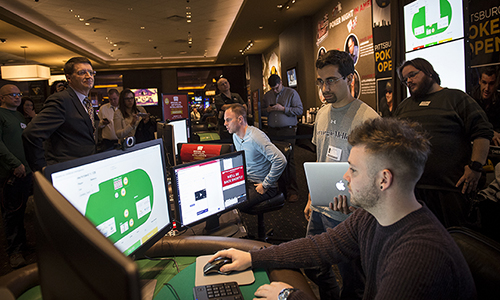
Chalk up another victory for artificial intelligence in the neverending “man versus machine” battle of supremacy in various forms of mindpower competitions. Libratus, the poker-playing AI developed by researchers at Carnegie Mellon University, closed out a convincing win in a lengthy heads-up no-limit hold’em contest against four separate and well respected poker pros at Pittsburgh’s Rivers Casino.
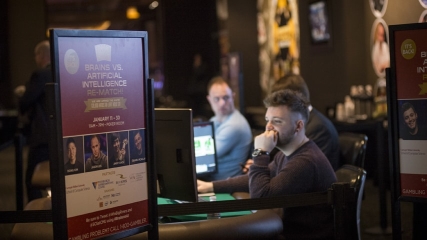
Rivers Casino in Pittsburgh hosted the battle between Libratus and four well-known professional poker players. (Source: cmu.edu)
The victory by the Libratus program in the “Brains Vs. Artificial Intelligence” tournament wasn’t really that close. The machine emerged victorious over 120,000 hands of play, spread out over 20 days. The four pros — Dong King, Daniel McAulay, Jimmy Chou, and Jason Les — combined to lose $1.766,250 in virtual chips to the program over the course of the 20-day competition.
Libratus went 4-0 when the overall results were broken down by individual matchups. King fared the best of the four pros, but the numbers were convincing by any reckoning:
Dong King: (-$85,649)
Daniel McAulay: (-$277,657)
Jimmy Chou: (-$552-857)
Jason Les: (-$880,087)
Libratus’s developers, a team led by Carnegie Mellon computer science professor Tuomas Sandholm, calculated that the margin of the win inferred that Libratus played a more skilled game over the course of the entire contest, with 97.7% certainty (or a 2.3% margin of error). Whether or not the program was exceptionally skillful, largely lucky, or both hardly matters, however. The success of the program here shows that AI can compete with the best at heads-up NLHE… even acknowledging that this is the simplest form of no-limit poker.
It’s another notch in the belt. From checkers to chess, from backgammon to Go, computers have proven a match for the best human brains in ever more complex endeavors. Poker, as one of a handful of prominent competitive games where actions are taken based on incomplete information, was always a tough challenge. The best AIs are indeed getting there; according to Sandholm’s resume, “the team that he leads is the reigning two-time world champion in computer Heads-Up No-Limit Texas Hold’em.”
In comments made to media during and after the competition, Sandholm credited much of Libratus’s success to veering away from a well-worn piece of poker advice — taken advantage of opponents’ mistakes. Instead, according to Sandholm, the AI was developed to modify and improve its own play in an attempt to approach a single, optimal HUNL strategy.
“We looked at fixing holes in our own strategy because it makes our own play safer and safer,” Sandholm told IEEE Spectrum, online home for The Institute of Electrical and Electronics Engineers [IEEE]. “When you exploit opponents, you open yourself up to exploitation more and more.”
“The algorithms we used are not poker specific,” Sandholm added. “They take as input the rules of the game and output strategy.”
The goals of Sandholm and his Carnegie Mellon team and of their chief rivals, such as the notable AI development team at the University of Alberta, are largely esoteric. These teams have focused on poker as a way to train AIs to operate successfully in areas of incomplete information, in the hope that the lessons learned will have real-world applications in a wide range of disciplines.
Whether or not those disciplines would include poker itself, for real money, aren’t a high priority, according to Sandholm, even though it seems plain that the pure gaming engine within the AI would make a highly successful “bot” on some online sites. Libratus’s convincing win won’t stem the ever-present chatter that these bots, which are a form of AI-based players, are already effectively dominating some forms of online play, such as HUNL or limit hold’em.
Truth be told, the computers will only get better. It’ll be up to the site operators themselves to develop ever more rigorous checks to provide AIs from being implemented on their tables. In that sense, Libratus’s convincing win isn’t so much a landmark achievement as it a signpost on a very predictable road, and one that operators with a long-term view must recognize and create ongoing plans to counterract.







COMMENTS